Do Mozambican People Would Like a Colonization Again Made by Portuga
| Province of Mozambique Moçambique | |||||||||||||
|---|---|---|---|---|---|---|---|---|---|---|---|---|---|
| 1505–1975 | |||||||||||||
| Flag Coat of arms | |||||||||||||
| Anthem: "Hymno Patriótico" (1808–34) Patriotic Anthem "Hino da Carta" (1834–1910) Hymn of the Charter "A Portuguesa" (1910–75) The Portuguese | |||||||||||||
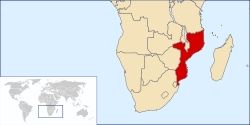 Location of Mozambique in Africa | |||||||||||||
| Condition | Colony of the Portuguese Empire (1505–1951) Overseas province of Portugal (1951–1972) State of the Portuguese Empire (1972–1975) | ||||||||||||
| Capital | Cidade de Pedra (1507- 1898) Lourenço Marques (1898–1975) | ||||||||||||
| Mutual languages | Portuguese | ||||||||||||
| Religion | Roman Catholicism | ||||||||||||
| Caput of state | |||||||||||||
| • 1505–1521 | King Manuel I of Portugal and the Algarves | ||||||||||||
| • 1974–75 | President Francisco da Costa Gomes | ||||||||||||
| Governor-General | |||||||||||||
| • 1505–1506 | Pêro de Anaia (first) | ||||||||||||
| • 1974–75 | Vítor Manuel Trigueiros Crespo (concluding) | ||||||||||||
| Historical era | Imperialism | ||||||||||||
| • Established | 1505 | ||||||||||||
| • Fall of Portuguese Empire | 25 June 1975 | ||||||||||||
| Currency | Mozambican real (1852–1914) Mozambican escudo (1914–75) | ||||||||||||
| ISO 3166 lawmaking | MZ | ||||||||||||
| |||||||||||||
| Today part of | Mozambique | ||||||||||||


Portuguese Mozambique (Portuguese: Moçambique) or Portuguese E Africa (África Oriental Portuguesa) were the common terms past which Mozambique was designated during the period in which it was a Portuguese colony. Portuguese Mozambique originally constituted a string of Portuguese possessions along the due south-e African declension, and afterwards became a unified colony, which now forms the Republic of Mozambique.
Portuguese trading settlements—and later on, colonies—were formed along the coast and into the Zambezi basin from 1498 when Vasco da Gama first reached the Mozambican coast. Lourenço Marques explored the area that is at present Maputo Bay in 1544. The Portuguese increased efforts for occupying the interior of the colony after the Scramble for Africa, and secured political command over well-nigh of its territory in 1918, facing the resistance of Africans during the process.
Some territories in Mozambique were handed over in the belatedly 19th century for rule past chartered companies like the Mozambique Company (Companhia de Moçambique), which had the concession of the lands corresponding to the present-mean solar day provinces of Manica and Sofala, and the Niassa Company (Companhia practise Niassa), which had controlled the lands of the modern provinces of Cabo Delgado and Niassa. The Mozambique Company relinquished its territories back to Portuguese control in 1942, unifying Mozambique nether control of the Portuguese authorities.
The region every bit a whole was long officially termed Portuguese Eastward Africa, and was subdivided into a series of colonies extending from Lourenço Marques in the s to Niassa in the north. Cabo Delgado was initially simply a strip of territory forth the Rovuma River, including Cape Delgado itself, which Portugal caused out of German East Africa in 1919, simply it was enlarged southward to the Lurio River to class what is now Cabo Delgado Province. In the Zambezi basin were the colonies of Quelimane (now Zambezia Province) and Tete (in the panhandle between Northern Rhodesia, at present Zambia, and Southern Rhodesia, now Zimbabwe), which were for a time merged every bit Zambezia. The colony of Moçambique (now Nampula Province) had the Isle of Mozambique equally its capital. The island was also the seat of the Governor-General of Portuguese Due east Africa until the late 1890s, when that official was officially moved to the urban center of Lourenço Marques. Also in the s was the colony of Inhambane, which lay north-east of Lourenço Marques. Once these colonies were merged, the region every bit a whole became known as Moçambique.
According to the official policy of the Salazar authorities, inspired on the concept of Lusotropicalismo, Mozambique was claimed as an integral part of the "pluricontinental and multiracial nation" of Portugal, as was done in all of its colonies to Europeanise the local population and assimilate them into Portuguese culture. This policy was largely unsuccessful, however, and African opposition to colonisation led to a ten-year independence war that culminated in the Carnation Revolution at Lisbon in Apr 1974 and the independence from Portugal in June 1975.
Designation [edit]
During its history equally a Portuguese colony, the nowadays-twenty-four hours territory of Mozambique had the following formal designations:
- 1505–1752: Captaincy of Sofala (Portuguese: Capitania de Sofala); Dependency of the Portuguese State of India.
- 1569–1752: Captaincy of Mozambique and Sofala (Capitania de Moçambique e Sofala); Dependency of the Portuguese Country of India.
- 1752–1836: Captaincy-General of Mozambique, Sofala and Rivers of Sena (Capitania-Geral de Moçambique, Sofala e Rios de Sena); Contained of the governor of the Portuguese State of India.
- 1836–1891: Province of Mozambique (Província de Moçambique)
- 1891–1893: State of Eastern Africa (Estado da África Oriental)
- 1893–1926: Province of Mozambique (Província de Moçambique)
- 1926–1951: Colony of Mozambique (Colónia de Moçambique)
- 1951–1972: Province of Mozambique (Província de Moçambique)
- 1973–1975: Land of Mozambique (Estado de Moçambique)
Overview [edit]

The Portuguese fortress São Sebastião on Mozambique Isle.
Until the 20th century, the land and peoples of Mozambique were barely affected past the Europeans who came to its shores and entered its major rivers. Equally the Muslim traders, mostly Swahili, were displaced from their littoral centres and routes to the interior past the Portuguese, migrations of Bantu peoples continued and tribal federations formed and reformed as the relative ability of local chiefs inverse. For four centuries the Portuguese presence was meagre. Coastal and river trading posts were built, abased, and built once again. Governors sought personal profits to take back to Portugal, and colonists were not attracted to the distant area with its relatively unattractive climate; those who stayed were traders who married local women and successfully maintained relations with local chiefs.
In Portugal, however, Mozambique was considered to be a vital part of a world empire. Periodic recognition of the relative insignificance of the revenues it could produce was tempered by the mystique which adult regarding the mission of the Portuguese to bring their civilisation to the African territory. It was believed that through missionary activeness and other direct contact between Africans and Europeans, the Africans could be taught to appreciate and participate in Portuguese culture.
In the concluding decade of the 19th century and the beginning office of the 20th century, integration of Mozambique into the structure of the Portuguese nation was begun. After all of the surface area of the present province had been recognised by other European powers as belonging to Portugal, administrators waged wars against African polities to assert command over the territory. Civil administration was established throughout the expanse, the building of an infrastructure was begun, and agreements regarding the transit merchandise of Mozambique's land-locked neighbours to the west, such equally Southern Rhodesia, Northern Rhodesia and Nyasaland, were made.
Colonial legislation discriminated against Africans on cultural grounds. Colonial legislation submitted Africans to forced labour, to pass laws and to segregation in schools. That most Africans were perceived to appoint in "uncivilised behaviour" by the Portuguese created a low opinion of Africans every bit a group among Europeans. The uneducated Portuguese immigrant peasants in urban areas were frequently in direct competition with Africans for jobs and demonstrated jealousies and racial prejudice.
Between the urban and rural sectors of the lodge lied a steadily increasing group of Africans who were loosening their ties with rural villages and starting to participate in the urban economy, to settle in suburbs, and to adopt European community. Members of this group would later become active participants in the independence movement.
History [edit]
When Portuguese explorers reached East Africa in 1498, Swahili commercial settlements had existed along the Swahili Coast and outlying islands for several centuries. From about 1500, Portuguese trading posts and forts became regular ports of telephone call on the new road to the east.
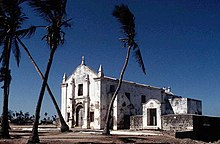
The Island of Mozambique was kickoff occupied by Portuguese explorers in the late 15th century. They quickly established a fort there, and with fourth dimension a community sprang up and accomplished importance as port of phone call, missionary base and a trading centre. The island is now a UNESCO World Heritage Site.
The voyage of Vasco da Gama around the Greatcoat of Good Hope into the Indian Ocean in 1498 marked the Portuguese entry into merchandise, politics, and society in the Indian Bounding main world. The Portuguese gained control of the Island of Mozambique and the port urban center of Sofala in the early 16th century. Vasco da Gama having visited Mombasa in 1498 was then successful in reaching Republic of india thereby permitting the Portuguese to trade with the Far Eastward directly by sea, thus challenging older trading networks of mixed country and sea routes, such as the spice trade routes that used the Farsi Gulf, Red Sea and caravans to attain the eastern Mediterranean.
The Commonwealth of Venice had gained command over much of the trade routes between Europe and Asia. After traditional land routes to Bharat had been closed by the Ottoman Turks, Portugal hoped to apply the bounding main route pioneered by da Gama to break the Venetian trading monopoly. Initially, Portuguese rule in East Africa focused mainly on a coastal strip centred in Mombasa. With voyages led by Vasco da Gama, Francisco de Almeida and Afonso de Albuquerque, the Portuguese dominated much of southeast Africa'due south declension, including Sofala and Kilwa, by 1515.[one] Their main goal was to dominate trade with Bharat. As the Portuguese settled forth the declension, they made their way into the hinterland as sertanejos (backwoodsmen). These sertanejos lived alongside Swahili traders and fifty-fifty took upwards service among Shona kings every bit interpreters and political advisors. One such sertanejo managed to travel through about all the Shona kingdoms, including the Mutapa Empire's (Mwenemutapa) metropolitan commune, betwixt 1512 and 1516.[two]
By the 1530s, modest groups of Portuguese traders and prospectors penetrated the interior regions seeking gold, where they fix upwardly garrisons and trading posts at Sena and Tete on the Zambezi River and tried to gain exclusive control over the gold trade. The Portuguese finally entered into straight relations with the Mwenemutapa in the 1560s.[3]
They recorded a wealth of information about the Mutapa kingdom besides as its predecessor, Great Republic of zimbabwe. Co-ordinate to Swahili traders whose accounts were recorded by the Portuguese historian João de Barros, Great Zimbabwe was an ancient capital city congenital of stones of marvellous size without the use of mortar. And while the site was not within Mutapa'southward borders, the Mwenemutapa kept noblemen and some of his wives there.[4]

The Portuguese attempted to legitimate and consolidate their merchandise and settlement positions through the cosmos of prazos (state grants) tied to Portuguese settlement and administration. While prazos were originally adult to be held by Portuguese, through intermarriage they became African Portuguese or African Indian centres defended by big African slave armies known equally Chikunda. Historically, within Mozambique, in that location was slavery.[5] Human beings were bought and sold by African tribal chiefs, Arab traders, and the Portuguese. Many Mozambican slaves were supplied past tribal chiefs who raided warring tribes and sold their captives to the prazeiros .
Although Portuguese influence gradually expanded, its power was express and exercised through private settlers and officials who were granted extensive autonomy. The Portuguese were able to wrest much of the coastal trade from Arabs between 1500 and 1700, but, with the Arab seizure of Portugal's central foothold at Fort Jesus on Mombasa Island (at present in Kenya) in 1698, the pendulum began to swing in the other direction. Equally a consequence, investment lagged while Lisbon devoted itself to the more lucrative merchandise with India and the Far East and to the colonisation of Brazil. During the 18th and 19th centuries, the Mazrui and Omani Arabs reclaimed much of the Indian Ocean trade, forcing the Portuguese to retreat south. Many prazos had declined past the mid-19th century, only several of them survived. During the 19th century, other European powers, particularly the British and the French, became increasingly involved in the merchandise and politics of the region. In the Island of Mozambique, the hospital, a purple neo-classical edifice constructed in 1877 by the Portuguese, with a garden decorated with ponds and fountains, was for many years the biggest infirmary south of the Sahara.[vi] Past the early 20th century the Portuguese had shifted the assistants of much of Mozambique to private chartered companies, including the Mozambique Company, the Zambezia Visitor and the Niassa Visitor, which established several railroad lines to neighbouring countries. The companies, granted a charter by the Portuguese authorities to foster economical development and maintain Portuguese control in the territory's provinces, would lose their purpose when the territory was transferred to the control of the Portuguese colonial authorities betwixt 1929 and 1942.

View of Lourenço Marques, ca. 1905

Former Portuguese administrative buildings and infirmary, on Mozambique Island.
Although slavery had been legally abolished in Mozambique past the Portuguese colonial authorities, at the end of the 19th century the Chartered companies enacted a forced labour policy and supplied inexpensive – oftentimes forced – African labour to the mines and plantations of other European colonies in Africa. The Zambezia Company, the most profitable chartered company, took over a number of smaller prazeiro holdings and requested Portuguese military outposts to protect its property. The chartered companies and the Portuguese administration built roads and ports to bring their goods to market including a railway linking Southern Rhodesia with the Mozambican port of Beira. Yet, the development'due south administration gradually started to laissez passer directly from the trading companies to the Portuguese government itself.
Considering of their unsatisfactory operation and because of the shift, under the Estado Novo regime of Oliveira Salazar, towards a stronger Portuguese control of the Portuguese Empire'due south economy, the companies' concessions were not renewed when they ran out. This was what happened in 1942 with the Mozambique Company, which, however, connected to operate in the agronomical and commercial sectors as a corporation, and had already happened in 1929 with the termination of the Niassa Company's concession.
In the 1950s, the Portuguese overseas colony was rebranded an overseas province of Portugal, and by the early 1970s, it was officially upgraded to the condition of Portuguese non-sovereign state, by which information technology would remain a Portuguese territory but with a wider administrative autonomy. The Forepart for the Liberation of Mozambique (FRELIMO), initiated a guerrilla campaign against Portuguese rule in September 1964. This disharmonize, forth with the 2 others already initiated in the other Portuguese colonies of Angola and Guinea, became office of the so-called Portuguese Colonial War (1961–74). From a military standpoint, the Portuguese regular army held the upper paw during all of the conflicts against the independentist guerrilla forces, which created favourable conditions for social evolution and economic growth until the end of the conflict in 1974.[7]
Later ten years of sporadic warfare and later Portugal'due south return to democracy through a leftist military coup in Lisbon which replaced Portugal's Estado Novo regime in favour of a armed forces junta (the Carnation Revolution of April 1974), FRELIMO took control of the territory. The talks that led to an agreement on Mozambique's independence, signed in Lusaka, were started. Inside a twelvemonth, almost the entire ethnic Portuguese population had left, many fleeing in fright (in mainland Portugal they were known as retornados ); others were expelled by the ruling power of the newly independent territory. Mozambique became contained from Portugal on 25 June 1975.
Government [edit]

Ponta Vermelha Palace, former residence of the Portuguese governor and current presidential palace of Mozambique

Flag of the Portuguese governor of Mozambique.
At least since the early 19th century, the legal status of Mozambique always considered it equally much a function of Portugal as Lisbon, but as a província ultramarina (overseas province) enjoyed special derogations to account for its distance from Europe.
From 1837, the highest government official in the province of Mozambique has e'er been the Governor-Full general, who reported straight to the Authorities in Lisbon, usually through the Minister of the Overseas. During some periods in the late 19th and the early 20th century, the governors-full general of Mozambique received the status of royal commissioners or of high commissioners, which gave them extended executive and legislative powers, equivalent to those of a government minister.
In the 20th century, the province was also bailiwick to the authoritarian Estado Novo government that ruled Portugal from 1933 to 1974, until the war machine coup in Lisbon, known as the Carnation Revolution. About members of the government of Mozambique were from Portugal, just a few were Africans. Nearly all members of the hierarchy were from Portugal, as nigh Africans did not accept the necessary qualifications to obtain positions.
The Regime of Mozambique, like the Portuguese Government itself, was highly centralised. Power was concentrated in the executive branch, and all elections, where they occurred, were carried out using indirect methods. From the Prime Minister's office in Lisbon, authority extended down to the remotest posts and regedorias of Mozambique through a rigid chain of command. The authority of the government of Mozambique was residual, primarily express to implementing policies already decided in Europe. In 1967, Mozambique also sent vii delegates to the National Associates in Lisbon.
The highest official in the province was the Governor-Full general, appointed past the Portuguese Council of Ministers on recommendation of the Overseas Minister. The Governor-Full general had both executive and legislative authority. A Government Council brash the Governor-Full general in the running of the province. The functional cabinet consisted of five secretaries appointed past the Overseas Minister on the advice of the Governor-Full general. A Legislative Council had limited powers and its main activeness was approving the provincial budget. Finally, an Economical and Social Council had to be consulted on all draft legislation, and the Governor-General had to justify his determination to Lisbon if he ignored its advice.
Mozambique was divided into ix districts, which were further subdivided into 61 municipalities ( concelhos ) and 33 circumscriptions ( circunscrições ). Each subdivision was then made upwards of three or 4 individual posts, 166 in all with an boilerplate of 40,000 Africans in each. Each district, except Lourenço Marques which was run by the Governor-General, was overseen by a governor. Near Africans only had contact with the Portuguese through the post ambassador, who was required to visit each village in his domain at least once a year.
The lowest level of administration was the regedoria , settlements inhabited by Africans living according to customary law. Each regedoria was run by a regulo , an African or Portuguese official called on the recommendation of local residents. Under the regulos , each village had its own African headman.
Each level of government could as well take an advisory board or council. They were established in municipalities with more 500 electors, in smaller municipalities or circumscriptions with more 300 electors, and in posts with more 20 electors. Each district also had its own board as well.
Ii legal systems were in strength — Portuguese ceremonious law and African customary constabulary. Until 1961, Africans were considered to exist Natives ( indígenas ), rather than citizens. Later 1961, the previous native laws were repealed and Africans gained de facto Portuguese citizenship.
Geography [edit]

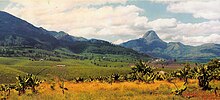
Mount Murresse in Gurué (tea plantation).

Armed forces route map of Portuguese Mozambique
Portuguese Due east Africa was located in south-eastern Africa. Information technology was a long coastal strip with Portuguese strongholds, from current day Tanzania and Kenya, to the s of current-solar day Mozambique.
In 1900, the part of modern Mozambique northwest of the Zambezi and Shire Rivers was called Moçambique ; the rest of information technology was Lourenço Marques . Various districts existed, and even issued stamps, during the first function of the century, including Inhambane, Lourenço Marques , Mozambique Colony, Mozambique Company, Nyassa Company, Quelimane, Tete, and Zambésia . The Nyassa Visitor territory is now Cabo Delgado and Niassa .
In the early- and mid-20th century, a number of changes occurred. Firstly, on 28 June 1919, the Treaty of Versailles transferred the Kionga Triangle, a one,000 km2 (390 sq mi) territory south of the Rovuma River from German Eastward Africa to Mozambique.
During World War Ii, the Lease of the Mozambique Company expired, on 19 July 1942; its territory, known equally Manica and Sofala, became a commune of Mozambique. Mozambique was constituted as four districts on 1 January 1943 — Manica and Sofala, Niassa , Sul do Save (South of the Salve River), and Zambézia .
On 20 October 1954, administrative reorganization caused Cabo Delgado and Mozambique districts to be split from Niassa . At the same time, the Sul do Save district was divided into Gaza, Inhambane and Lourenço Marques , while the Tete district was separate from Manica and Sofala.
By the early 1970s, Mozambique was bordering the Mozambique Channel, bordering the countries of Malawi, Rhodesia, S Africa, Swaziland, Tanzania, and Zambia. Roofing a total area of 801,590 km2 (309,500 square miles, slightly less than twice the size of California). With a tropical to subtropical climate, the Zambezi flows through the north-fundamental and most fertile part of the country. Its coastline had 2,470 km (1,530 miles), with 4,571 km (two,840 miles) of state boundaries, its highest point at Monte Binga (two,436 metres, 7,992 ft). The Gorongosa National Park, founded in 1920, was the main natural park in the territory.
The districts with its respective capitals were:
- Lourenço Marques — Lourenço Marques;[eight] [9]
- Gaza — João Belo;[10]
- Inhambane — Inhambane;[11]
- Beira — Beira;[12] [13]
- Vila Pery — Vila Pery;[14]
- Tete — Tete
- Zambézia — Quelimane;[15]
- Moçambique — Nampula
- Cabo Delgado — Porto Amélia;[sixteen]
- Niassa — Vila Cabral
Other important urban centres included Sofala, Nacala,[17] António Enes, Island of Mozambique and Vila Junqueiro.[15]
Demographics [edit]

Authoritative divisions and ethnic groups of Portuguese Mozambique, 1964
By 1970, the Portuguese Overseas Province of Mozambique had about 8,168,933 inhabitants. Virtually 300,000 were white ethnic Portuguese. There was a number of mulattoes, from both European and African ancestry, living across the territory. However, the vast majority of the population belonged to local tribal groups which included the Makua–Lomwe, the Shona and the Tsonga. Other ethnic minorities included British, Greeks, Chinese and Indians. Most inhabitants were black indigenous Africans with a variety of ethnic and cultural backgrounds, ranging from Shangaan and Makonde to Yao or Shona peoples. The Makua were the largest indigenous group in the due north. The Sena and Shona (mostly Ndau) were prominent in the Zambezi valley, and the Shangaan (Tsonga) dominated in the s. In addition, several other minority groups lived a tribal lifestyle across the territory.
Mozambique had around 250,000 Europeans in 1974 that made up around 3% of the population. Mozambique was cosmopolitan as it had Indian, Chinese, Greek and Anglophone communities (over 25,000 Indians and 5,000 Chinese past the early 1970s). The capital of Portuguese Mozambique, Lourenço Marques (Maputo), had a population of 355,000 in 1970 with around 100,000 Europeans. Beira had around 115,000 inhabitants at the time with around thirty,000 Europeans. Near of the other cities ranged from 10 to 15% in the number of Europeans, while Portuguese Angola cities had European majorities ranging from 50% to 60%.
Society [edit]

Wedding procession at Tete, from David Livingstone's Narrative of an Trek to the Zambesi and its Tributaries
Starting in 1926, Portugal's colonial authorities abandoned conceptions of an innate inferiority of Africans, and fix equally their goal the evolution of a multiethnic order in its African colonies. The establishment of a dual, racialised civil society was formally recognised in Estatuto do Indigenato (The Statute of Indigenous Populations) adopted in 1929, which was based on the subjective concept of civilization versus tribalism. In the administration'southward view, the goal of civilising mission would only exist accomplished after a menstruation of Europeanisation or enculturation of African communities.
The Estatuto established a distinction between the colonial citizens, subject to the Portuguese laws and entitled to all citizenship rights and duties constructive in the metropole, and the indígenas (natives), subjected to colonial legislation and customary African laws. Betwixt the 2 groups there was a tertiary minor group, the assimilados , comprising native blacks, mulatos, Asians, and mixed-race people, who had at to the lowest degree some formal education and non subjected to paid forced labour. They were entitled to some citizenship rights, and held a special identification card, used to command the movements of forced labour.[18] The indígenas were field of study to the traditional government, who were gradually integrated into the colonial administration and charged with solving disputes, managing the access to land, and guaranteeing the flows of workforce and the payment of taxes. As several authors accept pointed out,[19] the Indigenato regime was the political organization that subordinated the immense bulk of Africans to local authorities entrusted with governing, in collaboration with the lowest echelon of the colonial administration, the native communities described as tribes and assumed to have a common ancestry, language, and civilization. The colonial use of traditional law and structures of power was thus an integral office of the process of colonial domination.[20]
In the 1940s, the integration of traditional authorities into the colonial administration was deepened. The Portuguese colony was divided into concelhos (municipalities), in urban areas, governed by colonial and metropolitan legislation, and circunscrições (localities), in rural areas. The circunscrições were led past a colonial administrator and divided into regedorias (subdivisions of circunscrições), headed past régules (tribal chieftains), the embodiment of traditional authorities. Provincial Portuguese Decree No. v.639, of July 29, 1944, attributed to régulos and their assistants, the cabos de terra , the status of auxiliares da administração (administrative assistants). Gradually, these traditional titles lost some of their content, and the régulos and cabos de terra came to be viewed as an effective part of the colonial state, remunerated for their participation in the collection of taxes, recruitment of the labour force, and agricultural production in the area nether their command. Within the areas of their jurisdiction, the régulos and the cabos de terra also controlled the distribution of land and settled conflicts according to customary norms.[21] To exercise their ability, the régulos and cabos de terra had their ain police force.
The indigenato regime was abolished in 1960. From then on, all Africans were considered Portuguese citizens, and racial bigotry became a sociological rather than a legal feature of colonial society. In fact, the rule of traditional authorities became fifty-fifty more integrated than before in the colonial administration. Legally speaking, by the 1960s and 1970s segregation in Mozambique was minimal compared to that in neighbouring S Africa.
Urban centres [edit]

Central train station of Lourenço Marques (renamed equally Maputo)
The largest coastal cities, the outset founded or settled by Portuguese people since the 16th century, like the capital Lourenço Marques , Beira, Quelimane, Nacala and Inhambane, were modern cosmopolitan ports and a melting pot of several cultures, with a strong South African influence. The Southeast African and Portuguese cultures were dominant, but the influence of Arab, Indian, and Chinese cultures were also felt. The cuisine was diverse, owing especially to the Portuguese cuisine and Muslim heritage, and seafood was also quite abundant.
Lourenço Marques had always been a point of interest for artistic and architectural development since the offset days of its urban expansion and this strong artistic spirit was responsible for attracting some of the globe'south nigh forward-thinking architects at the turn of the 20th century. The city was home to masterpieces of building piece of work by, Pancho Guedes, Herbert Baker and Thomas Honney amongst others. The earliest architectural efforts around the city focused on classical European designs such every bit the Fundamental Train Station (CFM) designed by architects Alfredo Augusto Lisboa de Lima, Mario Veiga and Ferreira da Costa and built betwixt 1913 and 1916 (sometimes mistaken with the work of Gustav Eiffel),[22] and the Hotel Polana designed by Herbert Baker.
Throughout the 1960s and early 1970s, Lourenço Marques was still over again at the middle of a new wave of architectural influences made virtually popular by Pancho Guedes. The designs of the 1960s and 1970s were characterised by modernist movements of clean, straight and functional structures. However, prominent architects such every bit Pancho Guedes fused this with local art schemes giving the urban center's buildings a unique Mozambican theme. As a event, most of the properties erected during the 2d construction boom take on these styling cues.
Economy [edit]

Caeiro Lda. Tobacco Factory.
Since the 15th century, Portugal founded settlements, trading posts, forts and ports in the Sub-Saharan Africa's coast. Cities, towns and villages were founded all over East African territories past the Portuguese, especially since the 19th century, like Lourenço Marques, Beira, Vila Pery, Vila Junqueiro, Vila Cabral and Porto Amélia. Others were expanded and developed profoundly under Portuguese rule, like Quelimane, Nampula and Sofala. By this time, Mozambique had get a Portuguese colony, only assistants was left to the trading companies (like Mozambique Company and Niassa Visitor) who had received long-term leases from Lisbon. Past the mid-1920s, the Portuguese succeeded in creating a highly exploitative and coercive settler economy, in which African natives were forced to work on the fertile lands taken over by Portuguese settlers. Indigenous African peasants mainly produced cash crops designated for auction in the markets of the colonial metropole (the centre, i.e. Portugal). Major cash crops included cotton, cashews, tea and rice. This arrangement ended in 1932 later the takeover in Portugal by the new António de Oliveira Salazar's government — the Estado Novo . Thereafter, Mozambique, along with other Portuguese colonies, was put under the direct control of Lisbon. In 1951, it became an overseas province. The economy expanded chop-chop during the 1950s and 1960s, attracting thousands of Portuguese settlers to the country. It was effectually this time that the first nationalist guerrilla groups began to course in Tanzania and other African countries. The strong industrial and agricultural evolution that did occur throughout the 1950s, 1960s and early on 1970s was based on Portuguese development plans, and also included British and South African investment.
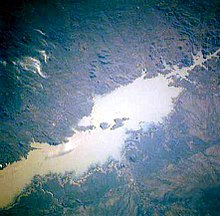
Cahora Bassa Dam reservoir — the dam began construction in 1969 and was at the time ane of the biggest in all of Africa.
In 1959–60, Mozambique's major exports included cotton, cashew nuts, tea, sugar, copra and sisal. Other major agricultural productions included rice and kokosnoot. The expanding economic system of the Portuguese overseas province was fuelled by foreign direct investment, and public investment which included ambitious state-managed development plans. British capital letter owned ii of the big sugar concessions (the 3rd was Portuguese), including the famous Sena states. The Matola Oil Refinery, Procon, was controlled past Great britain and the United States. In 1948 the petroleum concession was given to the Mozambique Gulf Oil Visitor. At Maotize, coal was mined; the manufacture was chiefly financed by Belgian capital. 60% of the capital of the Compagnie de Charbons de Mozambique was held by the Société Minière et Géologique Belge , xxx% by the Mozambique Company, and the remaining 10% by the Regime of the territory. Iii banks were in functioning, the Banco Nacional Ultramarino , Portuguese, Barclays Bank, D.C.O., British, and the Banco Totta e Standard de Moçambique (a partnership between Standard Bank of South Africa and mainland's Banco Totta & Açores ). Nine out of the xx-3 insurance companies were Portuguese, which included insurance companies related to Fidelidade throughout its history. fourscore% of life assurance was in the hands of foreign companies which testifies to the openness of the economy.
The Portuguese overseas province of Mozambique was the first territory of Portugal, including the European mainland, to distribute Coca-Cola. Lately the Lourenço Marques Oil Refinery was established by the Sociedade Nacional de Refinação de Petróleo (SONAREP) — a Franco-Portuguese syndicate. In the sisal plantations Swiss capital letter was invested, and in copra concerns, a combination of Portuguese, Swiss and French capital was invested. The large availability of uppercase from both Portuguese and international origin, allied to the wide range of natural resources and the growing urban population, lead to an impressive growth and development of the economy.
From the late stages of this notable menses of high growth and huge evolution effort started in the 1950s, was the construction of Cahora Bassa dam by the Portuguese, which started to fill in December 1974 after construction was commenced in 1969. In 1971 construction piece of work of the Massingir Dam began. At independence, Mozambique's industrial base of operations was well-developed past Sub-Saharan Africa standards, thank you to a boom in investment in the 1960s and early 1970s. Indeed, in 1973, value added in manufacturing was the sixth highest in Sub-Saharan Africa.
Economically, Mozambique was a source of agronomical raw materials and an earner of foreign commutation. It also provided a market for Portuguese manufacturers which were protected from local competition. Transportation facilities had been developed to exploit the transit trade of Southward Africa, Swaziland, Southern Rhodesia (which became Rhodesia in November 1965), Malawi, and Zambia, farm production for consign purposes had been encouraged, and assisting arrangements for the export of labour had been made with neighbouring countries. Industrial production had been relatively insignificant simply did brainstorm to increase in the 1960s. The economic structure generally favoured the taking of profits to Portugal rather than their reinvestment in Mozambique. The Portuguese interests which dominated in banking, industry, and agronomics, exerted a powerful influence on policy.
Education [edit]
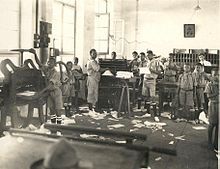
Portuguese language printing and typesetting class, 1930
Mozambique's rural population was largely illiterate. However, some thousands of Africans were educated in faith, the Portuguese language, and Portuguese history past Cosmic and Protestant missionary schools established in cities and in the countryside.
In 1930, principal schooling became racially segregated.[23] Africans who did not hold alloyed status had to enroll in "rudimentary schools," whereas whites and the few thousand assimilated Africans had access to "chief schools" of better quality.
Starting in the early 1940s, access to instruction was expanded in all levels. Nonetheless, "rudimentary schools" retained their poor quality. In 1956, in that location were 292,199 African students enrolled in showtime grade. Of these, only nine,486 had successfully passed third grade in 1959.[24] By 1970, just 7.vii% of Mozambique's population was literate.[25]
A comprehensive network of secondary schools (the Liceus ) and technical or vocational education schools were implemented across the cities and main towns of the territory. However, access to these institutions was largely express to whites. In 1960, simply thirty out of 1,000 students of the Liceu Salazar were Africans, in spite of whites making up but ii% of the Mozambican population.[26]
In 1962, the showtime Mozambican university was founded by the Portuguese authorities: the Universidade de Lourenço Marques .
Sports [edit]

The Clube Sport da Beira in the city of Beira.
The Portuguese-ruled territory was introduced to several popular European and North American sports disciplines since the early urbanistic and economic booms of the 1920s and 1940s. This period was a time of city and boondocks expansion and modernization that included the structure of several sports facilities for football, rink hockey, basketball, volleyball, handball, athletics, gymnastics, and swimming. Several sports clubs were founded across the entire territory, among them were some of the largest and oldest sports organizations of Mozambique similar Sporting Clube de Lourenço Marques established in 1920. Other major sports clubs were founded in the following years similar Grupo Desportivo de Lourenço Marques (1921), Clube Ferroviário de Lourenço Marques (1924), Sport Club de Vila Pery (1928), Clube Ferroviário da Beira (1943), Grupo Desportivo da Companhia Têxtil practice Punguè (1943), and Sport Lourenço Marques e Benfica (1955). Several sportsmen, especially football game players, that achieved wide notability in Portuguese sports were from Mozambique. Eusébio and Mário Coluna were examples of that, and excelled in the Portugal national football team. Since the 1960s, with the latest developments on commercial aviation, the highest ranked football teams of Mozambique and the other African overseas provinces of Portugal, started to compete in the Taça de Portugal (the Portuguese Cup). There were also several facilities and organizations for golf, tennis and wild hunting.
The nautical sports were too well developed and pop, especially in Lourenço Marques , home to the Clube Naval de Lourenço Marques . The largest stadium was the Estádio Salazar , located near Lourenço Marques . Opened in 1968, information technology was at the time the most advanced in Mozambique conforming to standards set by both FIFA and the Union Cycliste Internationale (UCI). The cycling track could be adjusted to allow for 20,000 more than seats.[27] Outset in the 1950s, motorsport was introduced to Mozambique. At commencement race cars would compete in areas effectually the metropolis, Polana and along the marginal merely as funding and interest increased, a dedicated race rail was built in the Costa Do Sol area along and backside the marginal with the ocean to the east with a length of 1.5 kilometres (0.93 miles). The initial surface of the new track, named Autódromo de Lourenço Marques did not provide enough grip and an accident in the tardily 1960s killed viii people and injured many more than. Therefore, in 1970, the rails was renovated and the surface changed to meet the highest international safety requirements that were needed at large events with many spectators. The length then increased to 3,909 kilometres (two,429 miles). The city became host to several international and local events get-go with the inauguration on 26 Nov 1970.[28]
Football was a very popular sport in Portuguese Mozambique. Mozambique saw a sizable population of Portuguese people immigrate there during the 20th century. This was a biproduct of the policies of the Estado Novo and how they saw their colonies. It would become increasingly popular equally it would spread throughout the colony. There was a lot of infrastructure in Mozambique to prepare the players to play professionally. This would permit many players form the colonies to easily play for the national teams. Players form Mozambique contributed a lot to the Portuguese Football success. Eusébio was a notable player from Mozambique and is considered i of the greatest football players.[29]
Carnation Revolution and independence [edit]


Lourenço Marques (nowadays Maputo) in 1925.
Every bit communist and anti-colonial ideologies spread out beyond Africa, many clandestine political movements were established in support of Mozambique's independence. These movements claimed that policies and development plans were primarily designed by the ruling government for the do good of the ethnic Portuguese population, affecting a majority of the ethnic population who suffered both state-sponsored discrimination and enormous social pressure. Many felt they had received likewise picayune opportunity or resource to upgrade their skills and improve their economical and social situation to a degree comparable to that of the Europeans. Statistically, Portuguese Mozambique's whites were indeed wealthier and more skilled than the black indigenous bulk, in spite of decreasing legal discrimination of Africans starting in the 1960s.
The Front end for the Liberation of Mozambique (FRELIMO), headquartered in Tanzania, initiated a guerrilla entrada against Portuguese dominion in September 1964. This conflict, along with the 2 others already initiated in the other Portuguese overseas territories of Republic of angola and Portuguese Guinea, became part of the Portuguese Colonial War (1961–74). Several African territories under European rule had accomplished independence in recent decades. Oliveira Salazar attempted to resist this tide and maintain the integrity of the Portuguese empire. By 1970, the anti-guerrilla war in Africa was consuming an important part of the Portuguese budget and there was no sign of a terminal solution in sight. This year was marked past a large-calibration armed forces operation in northern Mozambique, the Gordian Knot Operation, which displaced the FRELIMO'south bases and destroyed much of the guerrillas' military capacity. At a military level, a part of Portuguese Guinea was de facto independent since 1973, only the uppercase and the major towns were still under Portuguese control. In Angola and Mozambique, independence movements were only active in a few remote countryside areas from where the Portuguese Army had retreated. Even so, their impending presence and the fact that they wouldn't go away dominated public feet. Throughout the state of war period Portugal faced increasing dissent, arms embargoes and other punitive sanctions imposed by nearly of the international community. For the Portuguese club the war was becoming even more than unpopular due to its length and financial costs, the worsening of diplomatic relations with other United nations members, and the role it had ever played as a factor of perpetuation of the Estado Novo government. Information technology was this escalation that would atomic number 82 directly to the mutiny of members of the FAP in the Carnation Revolution in 1974 – an event that would lead to the independence of the former Portuguese colonies in Africa. A leftist armed services coup in Lisbon on 24 April 1974 by the Movimento das Forças Armadas (MFA), overthrew the Estado Novo authorities headed by Prime Minister Marcelo Caetano.
Every bit one of the objectives of the MFA, all the Portuguese overseas territories in Africa were offered independence. FRELIMO took complete control of the Mozambican territory after a transition period, every bit agreed in the Lusaka Accord which recognized Mozambique'southward right to independence and the terms of the transfer of power.
Within a twelvemonth of the Portuguese military insurrection at Lisbon, almost all of the Portuguese population had left the African territory as refugees (in mainland Portugal they were known as retornados ) – some expelled by the new ruling ability of Mozambique, some fleeing in fear. A parade and a state banquet completed the independence festivities in the uppercase, which was expected to exist renamed Tin Phumo, or "Place of Phumo", after a Tsonga primary who lived in the expanse before the Portuguese navigator Lourenço Marques founded the city in 1545 and gave his name to it. About city streets, named for Portuguese heroes or important dates in Portuguese history, had their names changed.[30]
Famous people [edit]
Gallery [edit]
-
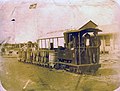
Narrow-gauge rails in Beira. 1897.
-

Inauguration of the "tramuei" (Tramway). Beira, 1901.
-

Volunteer firemen, 1903.
-

Beira, 1901.
-

Portuguese police force in 1925.
-

Observatory. 1930.
-

Agronomist office.
-

Brewery. Beira, 1930.
-

Teachers and students of the "School of Arts and Trades".
-

Border post betwixt Portuguese Mozambique and British-Swaziland, 1929.
Colonial architecture [edit]
-

Beachfront double estate. Beira, 1939.
-
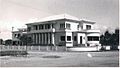
Large beachfront manor in Beira.
-

Beachfront manor in Beira, 1939.
-

Private residence in Beira. 1930.
-

Standard Bank building, Beira. 1925.
-
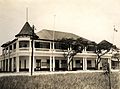
Beira Clube. Beira, 1930.
-
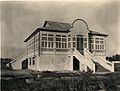
"Indo-Portuguese recreational center". Beira.
-

Hotel Polana 1929, once one of the largest and well-nigh luxurious in southern Africa.
-

Court. Beira, 1925.
-

Cine-Theater. Inhambane.
-

Colonial residence, Maputo.
-

Primary school, Maputo.
-

Maputo Naval Club.
Stampage [edit]
-

25 reis 1877
-

100 reis 1895
-

100 reis 1898.
-

115 reis 1915
-

1 escudo 1921
-
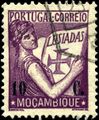
10 centavos 1933
Run across also [edit]

Proposed flag for Portuguese Mozambique
- Estado Novo (Portugal)
- History of Mozambique
- Listing of colonial governors of Mozambique
- Arquivo Histórico Ultramarino (archives in Lisbon documenting Portuguese Empire, including Mozambique)
- Portuguese Republic of angola
- Portuguese Guinea
References [edit]
- ^ Oliver, page 206
- ^ Oliver, page 207
- ^ Oliver, page 203
- ^ Oliver, folio 204
- ^ Silva, Filipa Ribeiro da, "Forms of Slavery and Patterns of Slave Belongings in Urban Mozambique in the 1820s", HumaNetten 47, 2021
- ^ Patrick Lages, The island of Mozambique, UNESCO Courier, May 1997.
- ^ CD do Diário de Notícias – Parte 08. YouTube. viii July 2007. Archived from the original on 2021-12-11.
- ^ Lourenço Marques "A cidade feitiço", a motion-picture show of Lourenço Marques, Portuguese Mozambique in 1970.
- ^ Lourenço Marques, a film of Lourenço Marques, Portuguese Mozambique.
- ^ João Belo — Xai-Xai, a film of João Belo, Portuguese Mozambique, before 1975.
- ^ Inhambane – no outro lado exercise tempo, brusk motion-picture show of Inhambane, Portuguese Mozambique earlier independence in 1975.
- ^ Cidade da Beira A short flick of Beira, Portuguese Mozambique.
- ^ Beira — Centenário — O meu Tributo A picture show about Beira, Portuguese Mozambique, its Grande Hotel, and the railway station. Mail-independence images of the city are shown, the film uses images of RTP one's TV program Grande Reportagem.
- ^ Vila Pery — Chimoio, a film of Vila Pery, Portuguese Mozambique.
- ^ a b Quelimane, a film of the cosmopolitan port of Quelimane and tea centre of Vila Junqueiro, Portuguese Mozambique, before 1975.
- ^ Porto Amélia — Pemba, a motion-picture show of Porto Amélia, Portuguese Mozambique.
- ^ Nacala — no outro lado do tempo, short film of Nacala, Portuguese Mozambique before independence in 1975.
- ^ CEA 1998
- ^ Mamdani 1996; Gentili 1999; O'Laughlin 2000.
- ^ Young 1994; Penvenne 1995; O'Laughlin 2000.
- ^ Geffray 1990; Alexander 1994; Dinerman 1999.
- ^ Morais, João Sousa. Maputo, Património da Estrutura e Forma Urbana, Topologia exercise Lugar . Livros Horizonte, 2001, p. 110. (in Portuguese)
- ^ O ensino indígena na colónia de Moçambique. Lourenço Marques: Imprensa Nacional. 1930. pp. v–9.
- ^ Duffy, James (1961). "Portuguese Africa (Angola and Mozambique): Some Crucial Bug and the Role of Didactics in Their Resolution". The Periodical of Negro Education. 30 (three): 301. doi:ten.2307/2294318. ISSN 0022-2984. JSTOR 2294318.
- ^ "Adult Literacy Rates – Historical Data Visualization – Business concern History – Harvard Business School". www.hbs.edu . Retrieved 2019-06-03 .
- ^ Mondlane, Eduardo (1983). The Struggle for Mozambique. London: Zed Books. p. 66.
- ^ "Estádio Salazar 1968". Flickr – Photo Sharing!. 28 July 2009.
- ^ Eurotux Due south.A. "Autódromo Lourenço Marques". Autosport. Archived from the original on 2011-ten-05.
- ^ Cleveland, Todd (2017). Following the Ball : The Migration of African Soccer Players Across the Portuguese Colonial Empire, 1949–1975. Athens, Ohio: Ohio University Press. ISBN978-0-89680-499-ix.
- ^ "Dismantling the Portuguese Empire". Time. 7 July 1975. Archived from the original on January 13, 2009.
Herrick, Allison and others (1969). "Expanse Handbook for Mozambique", Usa Authorities Printing Part.
Bibliography [edit]
- Gerardo Augusto Pery, ed. (1875). "Mocambique". Geographia e estatistica geral de Portugal e colonias (in Portuguese). Lisbon: Imprensa Nacional.
- "Portuguese East Africa" in the Cosmic Encyclopedia (1913)
Coordinates: 25°54′55″S 32°34′35″E / 25.9153°South 32.5764°E / -25.9153; 32.5764
Source: https://en.wikipedia.org/wiki/Portuguese_Mozambique

Post a Comment for "Do Mozambican People Would Like a Colonization Again Made by Portuga"